A neck gaiter is deceptively simple: one seamless tube of stretch fabric with no buttons, no ties, and no front or back. That simplicity is exactly why it has become a staple for anglers, skiers, runners, and event organizers alike. The same tube can sit around your neck on a cool morning, ride up over your nose when the wind picks up, or fold down into a headband when you start to sweat. Learning the handful of ways to wear one, and matching the fabric to what you actually do outdoors, is the difference between a gaiter you forget you are wearing and one that lives at the bottom of a drawer.
One piece of fabric, and why the shape matters
Most gaiters are cut from a single rectangle of four-way stretch knit, then either sewn into a tube with one flat seam or knit seamlessly in the round. A common finished size is roughly 9.8 by 19.7 inches laid flat (about 25 by 50 cm), which stretches to fit almost any adult head and neck. The seamless versions have no ridge to chafe under a helmet or hat, while seamed tubes are typically a little cheaper to produce at low volumes. Because the fabric is knit rather than woven, it recovers its shape after being pulled over your head dozens of times a day, and it breathes far better than a folded bandana of woven cotton.
The lack of a fixed front is the whole point. There is no correct orientation, so you can reposition the tube on the move without breaking stride, and any all-over print reads the same from every angle. That freedom is what makes the styling options below possible.
Eleven ways to wear a neck gaiter
The default position gives the product its name: stretch the tube, drop it over your head, and let it rest around your neck as a light collar against sun and wind. From there, pulling the front up over your mouth and nose creates a half face cover that most cyclists and hikers use for dust and glare, and pulling it higher until it reaches your ears and the back of your head becomes a full face cover for cold, wind-driven conditions.
Stretched over the whole head and tucked under the chin with a second layer below the eyes, the tube works as a balaclava and helmet liner for skiing. Pulled up and back it forms a hood that keeps heat in and holds sunglasses and hair in place. In hot weather, draping the fabric from your hairline down the back of the neck, sometimes called the Saharan or legionnaire style, shades your neck while staying breathable, and a knotted pirate wrap keeps sweat out of your eyes during watersports.
The rest of the repertoire is about your head. Turned inside out and twisted, the tube becomes a beanie; half-stretched across the forehead it is a bandana that filters UV during a summer workout; wrinkled and set low on the brow it is a sweat-catching headband for running; and folded one-third over the crown it forms a durag-style cap for casual wear. That is eleven distinct configurations from a single piece of fabric, which is why one gaiter often replaces a hat, a mask, and a headband in a packed bag.
Match the fabric weight to the job
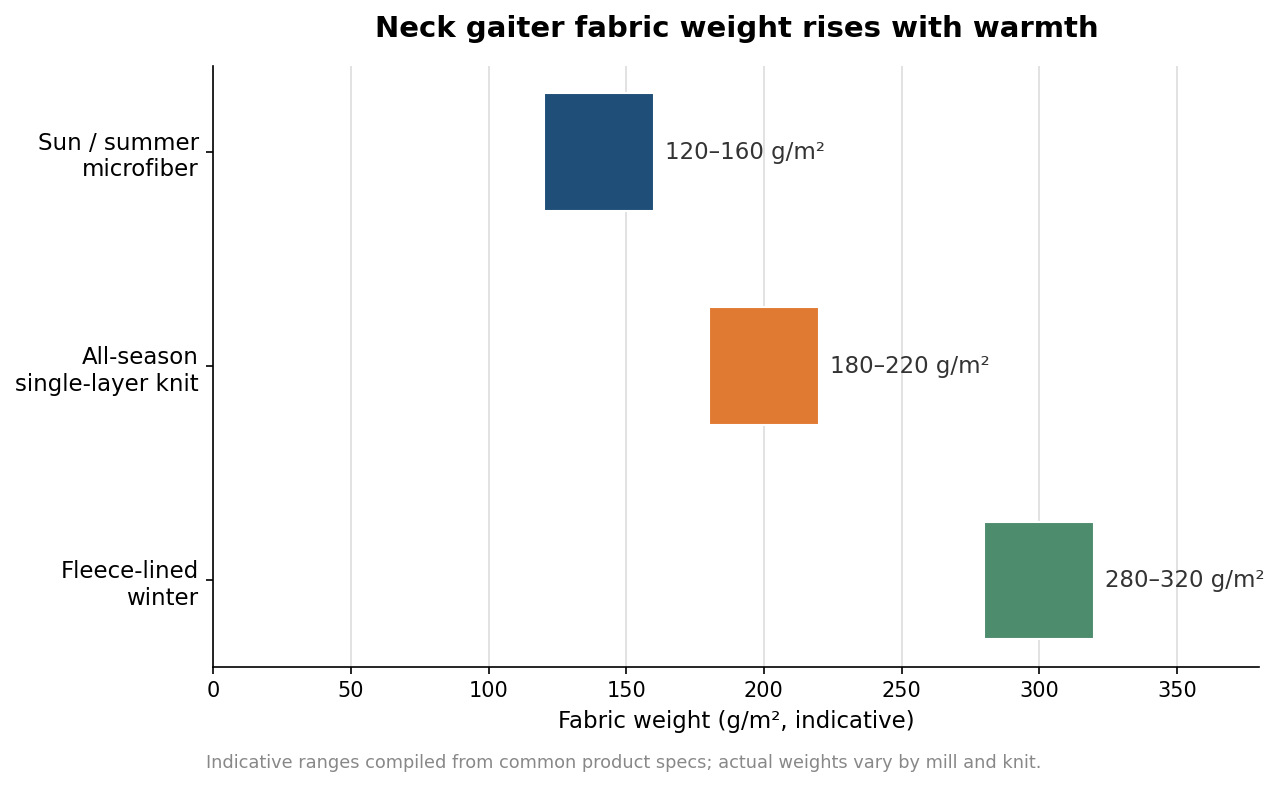
Not all gaiters are built for the same weather, and the quickest tell is fabric weight measured in grams per square meter. Sun and summer gaiters are usually thin 100% polyester microfiber in the range of about 120 to 160 g/m², light enough to soak and evaporate for evaporative cooling, and rated UPF 50+ when the knit is tight enough to block roughly 98% of UV. All-season single-layer knits sit around 180 to 220 g/m² and add a little wind resistance without becoming stifling. Fleece-lined winter tubes jump to roughly 280 to 320 g/m², trading breathability for warmth around the neck on cold days. These bands are indicative rather than exact; the same weight can feel warmer or cooler depending on knit structure and whether the fabric is brushed.
The practical rule is to buy for the condition you face most. A fishing or trail gaiter that will spend hours in direct sun wants the lightest UPF microfiber you can find, because a heavy fleece will leave you overheated by mid-morning. A ski or commuter gaiter that mostly fights cold wants the fleece weight, and an all-purpose one for mixed spring and fall use lands comfortably in the middle band.
Printing and ordering custom gaiters in bulk
Because the base fabric is polyester, gaiters are almost always decorated by dye sublimation, a process where heat turns solid dye into gas that bonds directly into the fibers. The result is an all-over, full-color print with no raised ink layer, nothing to crack or peel, and no loss of stretch or breathability. That makes gaiters an unusually good canvas for photographic camo, gradients, repeating logos, or full-bleed team artwork that a screen print could never wrap around a tube cleanly. For artwork, design to the flat panel dimensions and allow bleed on all edges, since there is no seam allowance to hide a misregistered logo.
The minimum order at Customized Neck Gaiters is 12, and unit cost falls with volume, so a full club or team order is best priced as one quote. The quote form gives you a firm number with a free mockup.
Choosing the right gaiter for your use case
Start from the dominant condition rather than the color. If your day is defined by sun exposure on water or open trail, choose the lightest UPF 50+ microfiber and plan to wear it as a half or full face cover with a Saharan drape when the sun is high. If cold and wind define the day, size up to a fleece weight and expect to live in the full face cover and balaclava positions. For high-output activity like running or cycling in mild weather, a mid-weight knit worn as a headband or neck collar sheds heat while still there when you need it. And if you are buying for a group or promotion, prioritize a full-color sublimated print on a versatile mid-weight tube, since it photographs well, suits the widest range of wearers, and is cost-effective once you order in volume. Get those two decisions right, fabric weight and print, and the eleven ways to wear it take care of themselves.