Almost every custom neck gaiter you have ever seen was printed by dye sublimation, and the reason comes down to what a gaiter is made of. A gaiter is a seamless tube of 100% polyester, usually around 9.8 by 19.7 inches laid flat, meant to stretch over a head, pull up over a nose, and get washed constantly. That combination — polyester, seamless, stretchy, all-over graphics — rules out most printing methods and plays perfectly to the strengths of one. Understanding why makes it far easier to design artwork that survives, and to spot a quote that is about to disappoint you.
This is a look at how the printing actually happens, what it can and cannot do, and where the handful of alternatives still earn their place. If you are ordering gaiters for a team, a race, a resort, or a giveaway, the method is the decision that quietly determines how the finished product looks and how long it lasts.
Why the fabric decides the method
Dye sublimation works by turning solid dye into a gas that bonds directly into polyester fibers under heat and pressure. The color becomes part of the fabric rather than a layer sitting on top of it. That single fact explains almost everything people like about sublimated gaiters: there is no printed film to crack when the tube stretches, no coating to stiffen the fabric, and nothing to peel in the wash. The graphic breathes exactly as much as the bare cloth does, which matters when the fabric is pulled across someone’s mouth on a hot trail.
It also explains the two real limits. Sublimation only bonds to polyester or polyester-coated surfaces, so a cotton or heavily cotton-blended gaiter is off the table. And sublimation dyes are translucent, so they need a white or light base to show true color. You cannot sublimate white ink or print pale artwork onto a dark gaiter and expect it to pop. Good designs work with this by treating the fabric’s base as part of the palette, or by printing a dark all-over background so the whole tube reads as “black” while every fiber is still technically dyed.
What sublimation does well on a gaiter
Because the print is edge-to-edge and seamless, sublimation handles the things a gaiter is bought for. All-over, full-color graphics are standard, not an upcharge for a second or third color the way spot printing works. Photographs, gradients, fine detail, and continuous patterns that wrap the entire tube all reproduce cleanly, since the process is closer to dyeing than to stamping. Durability is excellent: with the color embedded in the fiber, the artwork resists the fading, cracking, and wash-out that plague surface prints, and the fabric keeps its stretch and moisture-wicking behavior. For UPF sun gaiters and performance styles, that breathability is not a nice-to-have; a stiff printed patch would defeat the purpose.
The practical takeaway for artwork is to design in full color and to the edges, keep any critical logo away from the exact fold line where a nose or chin will crease it, and remember that the same file can cover the whole tube at no extra color cost. That freedom is the main reason gaiters became a canvas for elaborate designs in the first place.
When screen print, vinyl, or DTG make sense
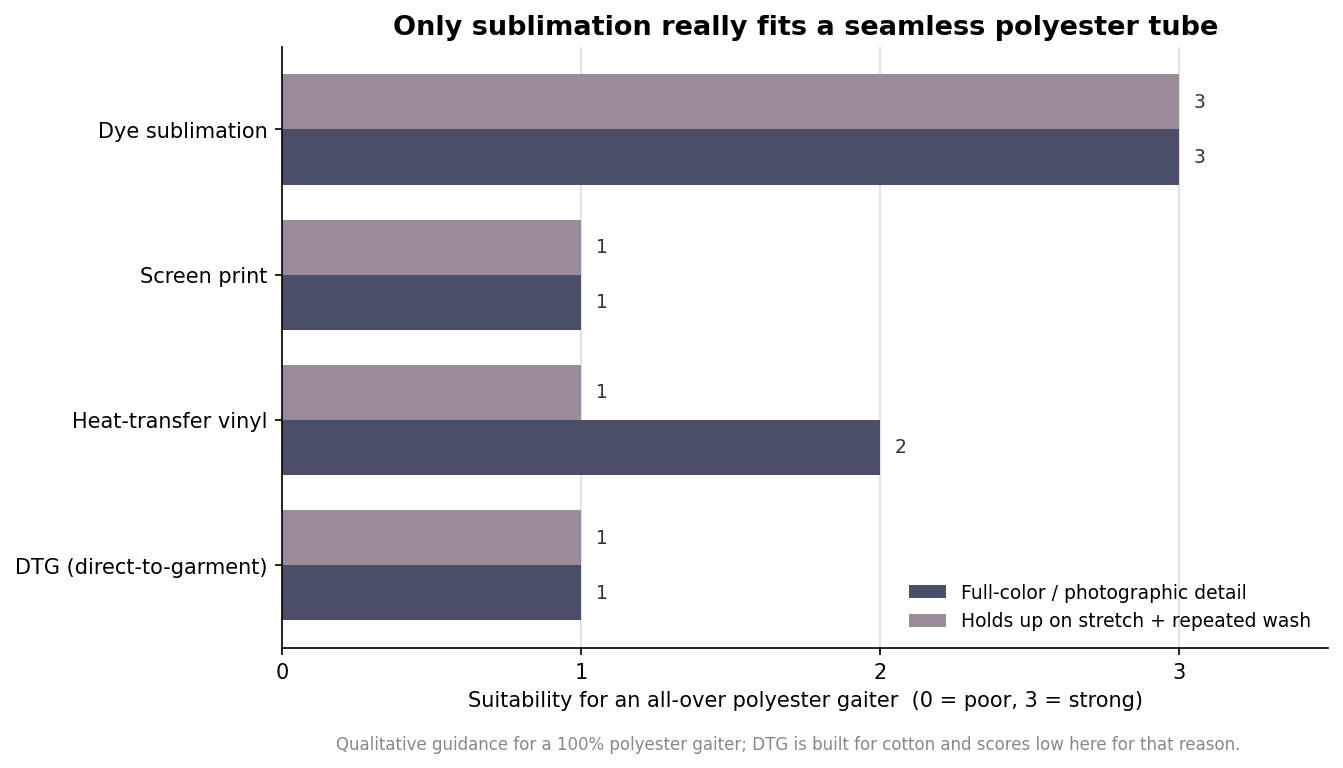
The alternatives are not useless, they are just built for different jobs. Screen printing lays ink on the surface and shines on cotton tees and tote bags, where it is durable and cost-effective at high volume. On a stretchy polyester tube it struggles: it is limited on gradients and color count, adds a hand feel, and the ink film can crack where the fabric flexes. It is vibrant on dark fabric, which is the one area sublimation is weak, but that rarely offsets its problems on a gaiter. Heat-transfer vinyl cuts a solid-color shape and presses it on; it is fine for a small, simple logo or a name, but a vinyl patch on something that stretches and folds is a strong candidate to peel over time. Direct-to-garment printing is designed for cotton and does not bond well to polyester, so it is essentially the wrong tool here despite being excellent elsewhere.
In short, reach for an alternative only when the design is a small, simple, single-color mark, or when the blank itself is not polyester. For anything full-color, all-over, or performance-oriented, sublimation is not just the best option, it is close to the only one that holds up.
What it costs, and how quantity moves the price
Sublimation carries no per-color setup the way screen printing does, so the price is driven mainly by fabric, size, and quantity rather than by how complex your artwork is. That is why a photographic, ten-color design costs the same to print as a two-color one. What changes the number most is volume. A single sample piece costs far more per unit because the setup is spread across one gaiter, while the same gaiter ordered in volume costs much less each, and the savings flatten out as quantities climb. The steepest per-unit savings come in the first few dozen pieces.
Two ordering notes follow from that. First, minimums: the minimum order at Customized Neck Gaiters is 12, which keeps small runs possible while still getting you into volume pricing. Second, plan lead time of about 2 weeks for a custom order, since the blanks are printed, heat-set, cut, and sewn to order rather than pulled from a shelf. If you need a specific in-hands date, build that timeline in from the start, and order a small buffer over your headcount.