Two neck gaiters can look identical on a product page and feel like completely different garments in the hand. One is a whisper-thin tube you forget you are wearing on a summer trail; the other is a dense, warm collar you pull up against a January wind. The spec that separates them is not the fiber name or the print, it is the fabric weight, measured in grams per square meter. Get the GSM right for how the gaiter will actually be used and everything else falls into place; get it wrong and even a beautiful print sits on fabric that is too hot, too flimsy, or too stiff for the job. This is a guide to reading weight and fiber before you order.
Why GSM is the spec that decides comfort
GSM, grams per square meter, is a direct measure of how much fabric you get in a given area, and for a stretchy knit it tracks closely with warmth, opacity, and hand feel. A higher number means more yarn packed into the same space, which traps more air and more heat and blocks more light, at the cost of breathability and packability. A lower number breathes and dries faster and disappears under a shirt collar, but offers little insulation and can feel insubstantial. Because a gaiter is worn against the most temperature-sensitive part of the body, small differences in weight are felt immediately. That is why two gaiters at the same price can earn opposite reviews: the buyers wanted different weights and only one of them got it.
The three weight classes
Knit fabrics sort into three broad weight bands, and the same bands that describe fleece describe gaiter fabric well. Lightweight sits at roughly 100 to 200 GSM, midweight at 200 to 300, and heavyweight above 300. The chart below lines them up with the trade-off each one makes. A thin summer sun gaiter lives at the bottom of the lightweight band, prized for breathing well and packing to nothing. An all-season gaiter in the midweight range is the versatile middle, warm enough for a cool morning and still wearable once the sun is up. A fleece or fleece-lined gaiter in the heavyweight band is built for cold and for standing still in it, trading airflow for genuine insulation.
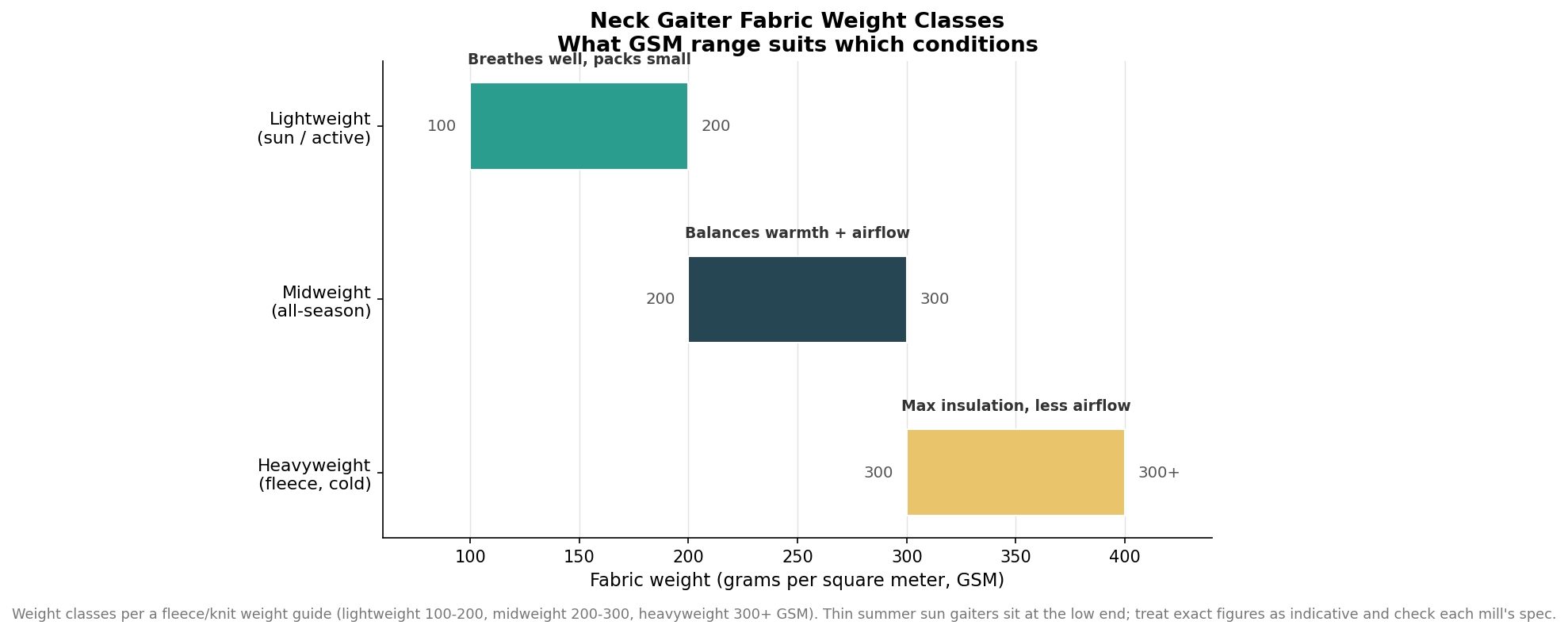
Treat the exact numbers as indicative rather than absolute, because construction matters alongside weight. A dense flat knit and an airy jersey at the same GSM will not feel the same, and a mill’s published figure can carry a tolerance of several grams. The bands are a planning tool for matching fabric to conditions, not a precise thermostat.
Matching weight to how the gaiter gets used
Start from the wearer and the weather, not from a catalog. For sun protection on the water, the trail, or the job site in warm months, a lightweight fabric is the goal, because the wearer needs coverage and airflow far more than warmth, and a heavy gaiter in that setting just gets soaked and stifling. For a general-purpose gaiter that a team will pull on across spring and fall, midweight is the safe default, forgiving of a range of temperatures and comfortable during light activity. For ski lifts, winter dog walks, cold-weather work, and anyone who runs cold, a heavyweight or fleece-lined gaiter is worth the loss of breathability because retaining heat is the entire point. If you are buying one design for a mixed group or an unknown climate, midweight annoys the fewest people; if you know the use is squarely hot or squarely cold, commit to the end of the range that fits it.
Fiber blends: what wicks, what warms, what prints
Weight sets the warmth; fiber sets how the fabric handles sweat, stretch, and ink. Nearly all performance gaiters are a synthetic paired with spandex for recovery, and the synthetic you choose changes the behavior. The clearest way to see it is standard moisture regain, the amount of water a fiber naturally holds, shown in the second chart. Polyester sits far lower than the others, which is exactly why polyester-spandex is the common choice for hot, sweaty use: it barely absorbs water, so it wicks to the surface and dries quickly. Nylon-spandex is a durable, soft all-rounder that holds a little more moisture. Cotton blends feel pleasant for casual wear but hold far more water and dry slowly, which is why they turn clammy under exertion. Merino wool is the outlier, holding a lot of moisture yet buffering humidity and resisting odor, though it too is slower to dry than polyester.
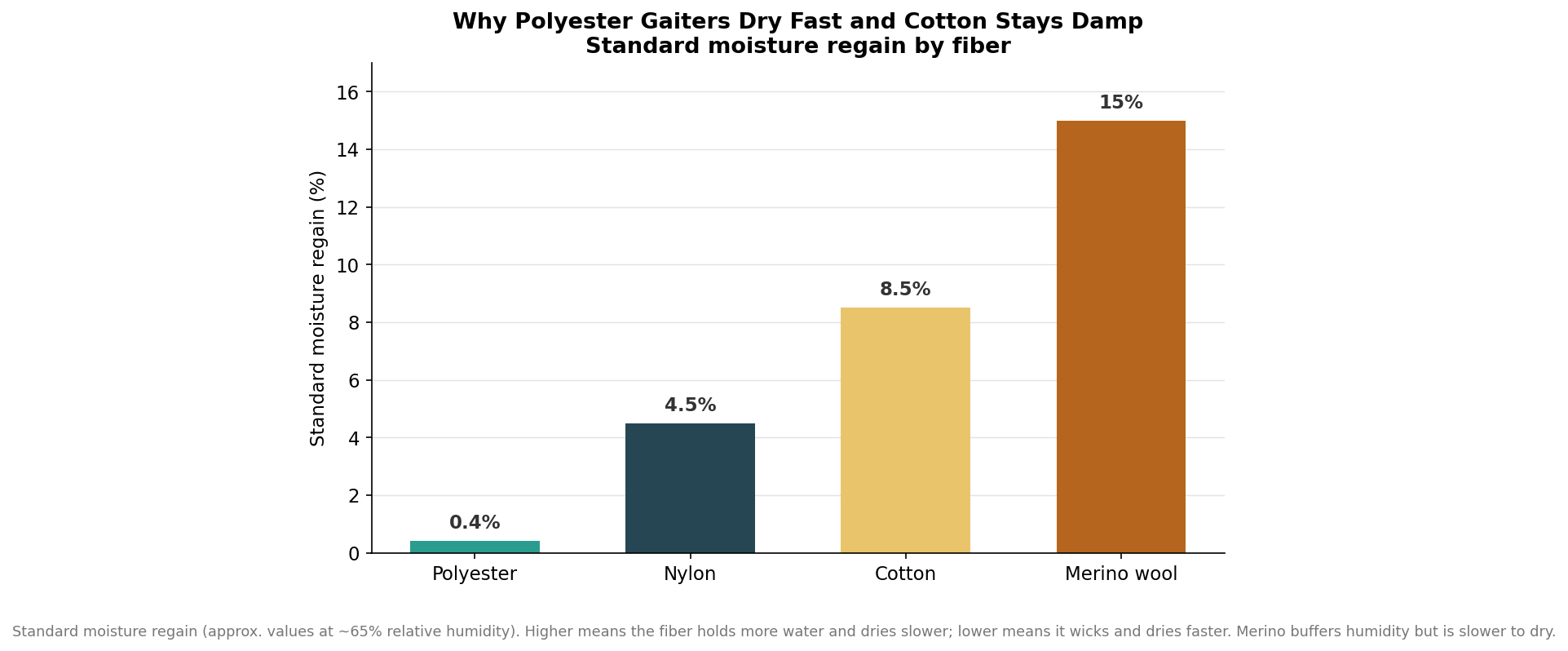
Fiber also decides how the gaiter is decorated. Dye sublimation, the process that prints edge-to-edge, all-over color into the fabric rather than on top of it, bonds to polyester specifically, which is another reason full-color custom gaiters are usually built on a polyester base. If a design needs to wrap the entire tube with no seams or blank panels, a high-polyester fabric is not just a wicking choice, it is a printing requirement. When you also want four-way stretch for an easy pull-on and a stable fit, a polyester-spandex or nylon-spandex knit gives you the recovery to hold shape wash after wash.
Reading a spec sheet before you order
Before you commit a bulk run, confirm four things on the fabric spec. Check the GSM and match it to the weight band your use calls for, rather than trusting words like “lightweight” that different mills define differently. Check the fiber blend, favoring a high-polyester content for hot-weather wicking and sublimation, or a fleece for genuine cold. Confirm the fabric offers four-way stretch so it pulls on easily and recovers its shape. And if sun protection is part of the promise, confirm the UPF rating is stated for that specific fabric, since UPF depends on the knit density and finish, not on the fiber name alone. Order a physical sample whenever you can, because a number on a page cannot tell you how the fabric feels against the neck.
Standard turnaround on custom sublimated gaiters from Customized Neck Gaiters is about 2 weeks from approved artwork. Spend the small effort up front to match weight and fiber to the real use, and the finished gaiter does its job quietly, which is the highest compliment a piece of fabric worn on the neck can earn.