A neck gaiter is marketed as sun protection more often than almost any other quality, and the shorthand for that claim is a UPF number, usually UPF 50+. The rating is real and it is measurable, but it is easy to misread, both by buyers who assume a bigger number is dramatically better and by sellers who print the figure without saying how it was earned. If you are ordering custom gaiters in any quantity, it pays to understand exactly what the rating describes, how it is tested, and what everyday use does to it, because the difference between a labeled number and delivered protection comes down to a few specifics.
UPF measures fabric, not sunscreen
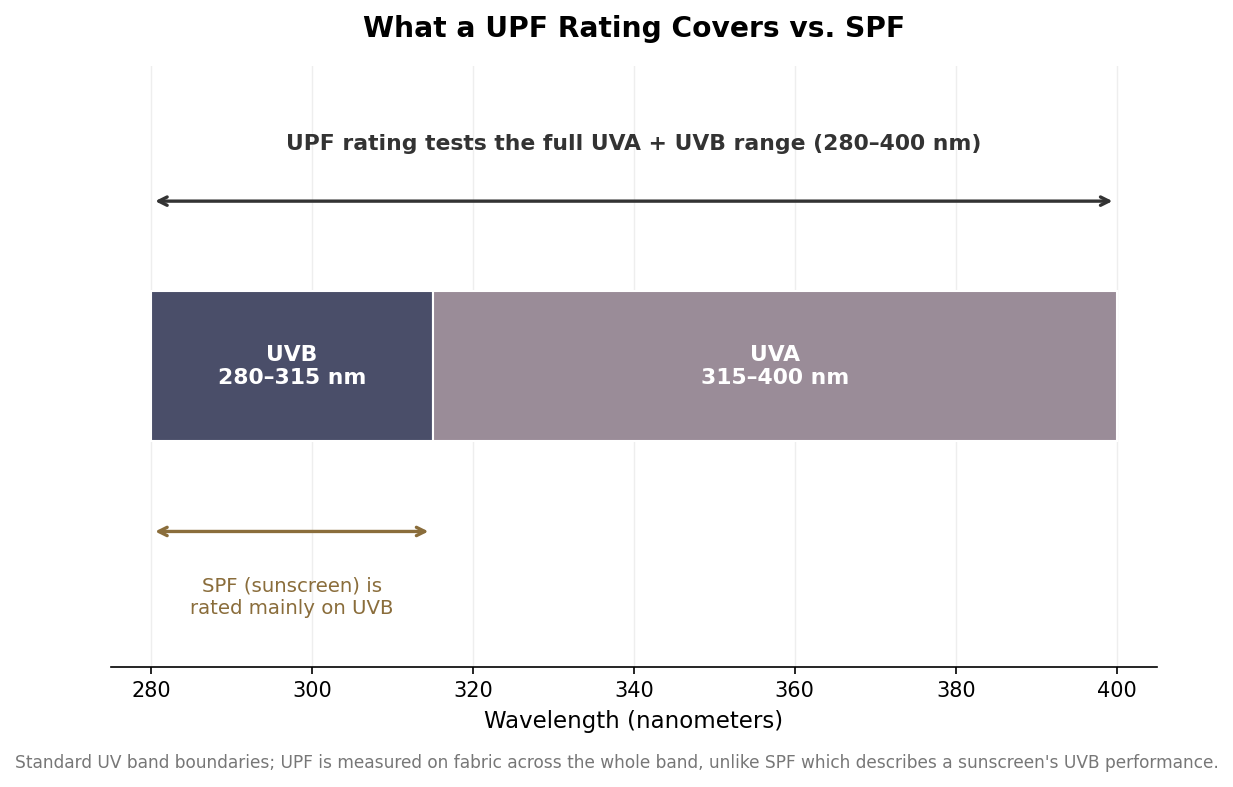
UPF stands for Ultraviolet Protection Factor, and it describes how much ultraviolet light a fabric lets through to the skin. This is a different thing from SPF, the number on a bottle of sunscreen. SPF rates a topical product and is driven mainly by protection against UVB, the sunburn band of the spectrum. UPF rates a textile across the whole ultraviolet range that reaches the ground, both UVA and UVB, so it speaks to a broader kind of exposure than an SPF figure does. When a gaiter says UPF 50+, it is making a claim about the cloth itself blocking UV, independent of anything you put on your skin.
What the rating number actually means
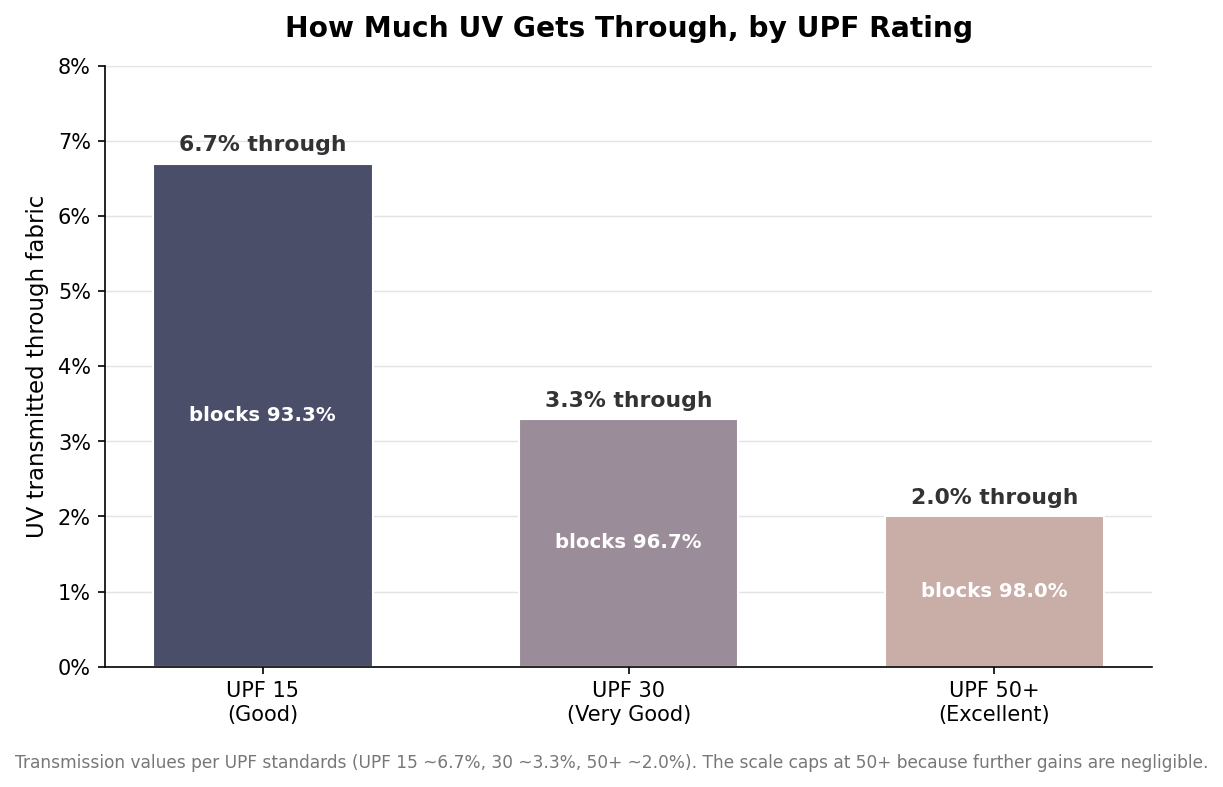
The UPF scale is banded into three named tiers. UPF 15 to 24 is rated Good, 25 to 39 is Very Good, and 40 to 50+ is Excellent. Translated into how much UV is stopped, a UPF 15 fabric blocks about 93.3 percent of UV and lets roughly 6.7 percent through; UPF 30 blocks about 96.7 percent; and UPF 50 blocks close to 98 percent, with only about 2 percent getting through. The scale deliberately stops at 50+ because the gains above that point are small in absolute terms. Moving from UPF 15 to UPF 50 roughly cuts the UV reaching your skin from about one-fifteenth to one-fiftieth, but moving from UPF 50 to some hypothetical UPF 80 shaves off a fraction of a percent that has little real-world meaning. Reading the numbers as transmission rather than as a bigger-is-always-better score makes the diminishing returns obvious.
How UPF is tested in a lab
The rating comes from an instrument, not an estimate. In the United States the standard is AATCC 183, and internationally the closely related AS/NZS 4399 from Australia and New Zealand is used; the two are substantively similar. A laboratory places a fabric sample in a spectrophotometer, which shines ultraviolet light through the cloth and records how much passes through at each wavelength, typically in five-nanometer steps across the 280 to 400 nanometer range that covers both UVB and UVA. Those transmission readings are combined into the single UPF figure you see on the label. One caveat is worth knowing: the base AATCC 183 rating does not require wash-durability testing as a condition of the initial number, so a fabric is rated as tested, not necessarily as it will perform after a season of laundering. Manufacturers can run and report post-wash results separately, and a supplier who has done so is worth asking.
What raises or lowers a gaiter’s real protection
Several properties of the fabric decide where it lands on the scale, and most of them are within a buyer’s control when specifying a custom run. Knit tightness matters most: densely constructed cloth leaves less space between yarns for UV to slip through, so a tight microfiber knit outperforms an open, airy one. Color counts too, because darker and more saturated shades absorb more UV than pale ones, which means a navy or black gaiter generally protects better than a light heather at the same fabric weight. Fiber choice pushes the same direction: polyester and nylon disrupt UV effectively on their own, while untreated natural fibers like cotton let more through unless they are specially finished.
Two use conditions specific to gaiters can quietly erode the rated number. Moisture lowers UPF for many fabrics as water fills the gaps and changes how light passes through, though some synthetics hold their protection better when wet than natural fibers do. And stretch is the one most people overlook. A gaiter is a tube pulled over the head and often stretched across the nose and cheeks; a fabric stretched thin has more space between its yarns and loses a meaningful share of its protection exactly where it is stretched tightest. A rating measured on a relaxed sample is a best case, so fit and fabric weight matter for holding the number in real use.
What to ask for when you order
Specifying protection well is mostly a matter of asking the right questions before a run. Ask for the tested UPF and the standard it was measured against, AATCC 183 or AS/NZS 4399, rather than accepting an unsourced “UPF 50+” on its own. If the gaiters will be laundered often, ask whether the fabric has any post-wash UPF data, since the base rating does not guarantee durability. Where sun performance is the point, lean toward a tighter synthetic knit in a deeper color and a fabric weight that will not sheer out when stretched over the face. Printing and dye methods can also interact with the base fabric’s protection, so if you are sublimating a full-coverage design, it is reasonable to ask the supplier how the finished, printed gaiter tests rather than assuming the blank’s rating carries straight through. None of this requires you to become a textile chemist; it just means treating the UPF number as a tested result with conditions attached, which is exactly what it is.