Category: Uncategorized

  • Neck Gaiter Fabric Weight and Fiber: A GSM Guide to Warmth, Wicking, and Sublimation

    Neck Gaiter Fabric Weight and Fiber: A GSM Guide to Warmth, Wicking, and Sublimation

    Two neck gaiters can look identical on a product page and feel like completely different garments in the hand. One is a whisper-thin tube you forget you are wearing on a summer trail; the other is a dense, warm collar you pull up against a January wind. The spec that separates them is not the fiber name or the print, it is the fabric weight, measured in grams per square meter. Get the GSM right for how the gaiter will actually be used and everything else falls into place; get it wrong and even a beautiful print sits on fabric that is too hot, too flimsy, or too stiff for the job. This is a guide to reading weight and fiber before you order.

    Why GSM is the spec that decides comfort

    GSM, grams per square meter, is a direct measure of how much fabric you get in a given area, and for a stretchy knit it tracks closely with warmth, opacity, and hand feel. A higher number means more yarn packed into the same space, which traps more air and more heat and blocks more light, at the cost of breathability and packability. A lower number breathes and dries faster and disappears under a shirt collar, but offers little insulation and can feel insubstantial. Because a gaiter is worn against the most temperature-sensitive part of the body, small differences in weight are felt immediately. That is why two gaiters at the same price can earn opposite reviews: the buyers wanted different weights and only one of them got it.

    The three weight classes

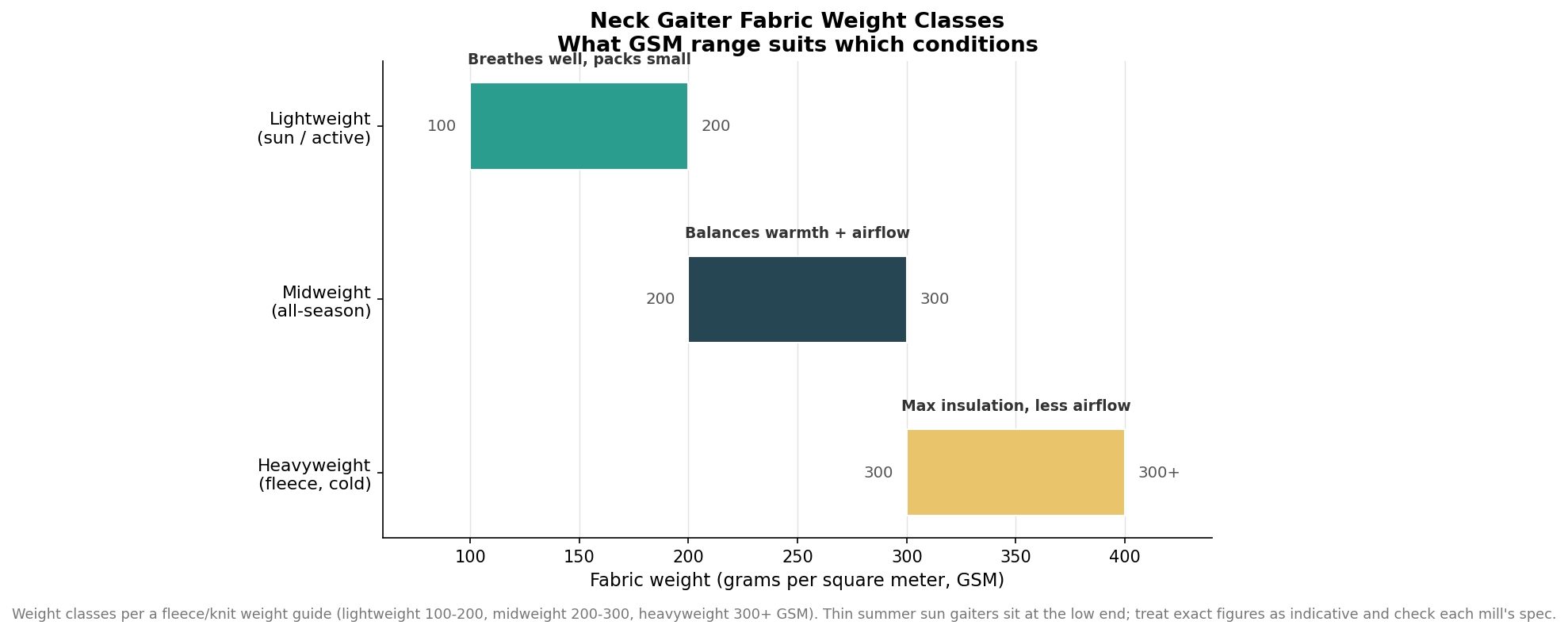
    Knit fabrics sort into three broad weight bands, and the same bands that describe fleece describe gaiter fabric well. Lightweight sits at roughly 100 to 200 GSM, midweight at 200 to 300, and heavyweight above 300. The chart below lines them up with the trade-off each one makes. A thin summer sun gaiter lives at the bottom of the lightweight band, prized for breathing well and packing to nothing. An all-season gaiter in the midweight range is the versatile middle, warm enough for a cool morning and still wearable once the sun is up. A fleece or fleece-lined gaiter in the heavyweight band is built for cold and for standing still in it, trading airflow for genuine insulation.
    Floating range bar chart of neck gaiter fabric weight classes in GSM: lightweight 100-200, midweight 200-300, heavyweight 300 plus, with the trade-off for each
    Fabric weight classes in GSM and the warmth-versus-breathability trade-off each one makes.

    Treat the exact numbers as indicative rather than absolute, because construction matters alongside weight. A dense flat knit and an airy jersey at the same GSM will not feel the same, and a mill’s published figure can carry a tolerance of several grams. The bands are a planning tool for matching fabric to conditions, not a precise thermostat.

    Matching weight to how the gaiter gets used

    Start from the wearer and the weather, not from a catalog. For sun protection on the water, the trail, or the job site in warm months, a lightweight fabric is the goal, because the wearer needs coverage and airflow far more than warmth, and a heavy gaiter in that setting just gets soaked and stifling. For a general-purpose gaiter that a team will pull on across spring and fall, midweight is the safe default, forgiving of a range of temperatures and comfortable during light activity. For ski lifts, winter dog walks, cold-weather work, and anyone who runs cold, a heavyweight or fleece-lined gaiter is worth the loss of breathability because retaining heat is the entire point. If you are buying one design for a mixed group or an unknown climate, midweight annoys the fewest people; if you know the use is squarely hot or squarely cold, commit to the end of the range that fits it.

    Fiber blends: what wicks, what warms, what prints

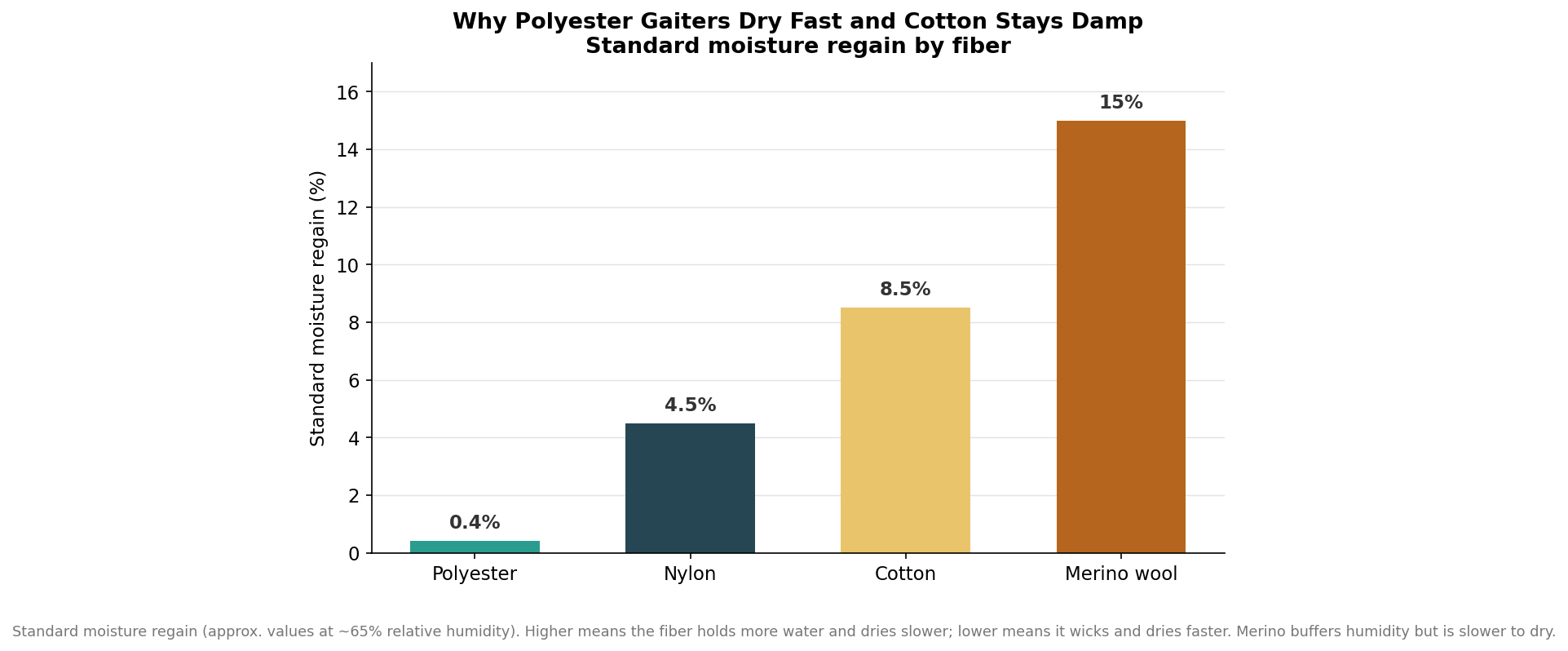
    Weight sets the warmth; fiber sets how the fabric handles sweat, stretch, and ink. Nearly all performance gaiters are a synthetic paired with spandex for recovery, and the synthetic you choose changes the behavior. The clearest way to see it is standard moisture regain, the amount of water a fiber naturally holds, shown in the second chart. Polyester sits far lower than the others, which is exactly why polyester-spandex is the common choice for hot, sweaty use: it barely absorbs water, so it wicks to the surface and dries quickly. Nylon-spandex is a durable, soft all-rounder that holds a little more moisture. Cotton blends feel pleasant for casual wear but hold far more water and dry slowly, which is why they turn clammy under exertion. Merino wool is the outlier, holding a lot of moisture yet buffering humidity and resisting odor, though it too is slower to dry than polyester.
    Bar chart of standard moisture regain by fiber: polyester 0.4 percent, nylon 4.5, cotton 8.5, merino wool 15 percent
    Standard moisture regain by fiber: polyester holds the least water, so it wicks and dries fastest.

    Fiber also decides how the gaiter is decorated. Dye sublimation, the process that prints edge-to-edge, all-over color into the fabric rather than on top of it, bonds to polyester specifically, which is another reason full-color custom gaiters are usually built on a polyester base. If a design needs to wrap the entire tube with no seams or blank panels, a high-polyester fabric is not just a wicking choice, it is a printing requirement. When you also want four-way stretch for an easy pull-on and a stable fit, a polyester-spandex or nylon-spandex knit gives you the recovery to hold shape wash after wash.

    Reading a spec sheet before you order

    Before you commit a bulk run, confirm four things on the fabric spec. Check the GSM and match it to the weight band your use calls for, rather than trusting words like “lightweight” that different mills define differently. Check the fiber blend, favoring a high-polyester content for hot-weather wicking and sublimation, or a fleece for genuine cold. Confirm the fabric offers four-way stretch so it pulls on easily and recovers its shape. And if sun protection is part of the promise, confirm the UPF rating is stated for that specific fabric, since UPF depends on the knit density and finish, not on the fiber name alone. Order a physical sample whenever you can, because a number on a page cannot tell you how the fabric feels against the neck.

    Standard turnaround on custom sublimated gaiters from Customized Neck Gaiters is about 2 weeks from approved artwork. Spend the small effort up front to match weight and fiber to the real use, and the finished gaiter does its job quietly, which is the highest compliment a piece of fabric worn on the neck can earn.
  • How Custom Neck Gaiters Are Printed: Sublimation vs the Alternatives

    How Custom Neck Gaiters Are Printed: Sublimation vs the Alternatives

    Almost every custom neck gaiter you have ever seen was printed by dye sublimation, and the reason comes down to what a gaiter is made of. A gaiter is a seamless tube of 100% polyester, usually around 9.8 by 19.7 inches laid flat, meant to stretch over a head, pull up over a nose, and get washed constantly. That combination — polyester, seamless, stretchy, all-over graphics — rules out most printing methods and plays perfectly to the strengths of one. Understanding why makes it far easier to design artwork that survives, and to spot a quote that is about to disappoint you.

    This is a look at how the printing actually happens, what it can and cannot do, and where the handful of alternatives still earn their place. If you are ordering gaiters for a team, a race, a resort, or a giveaway, the method is the decision that quietly determines how the finished product looks and how long it lasts.

    Why the fabric decides the method

    Dye sublimation works by turning solid dye into a gas that bonds directly into polyester fibers under heat and pressure. The color becomes part of the fabric rather than a layer sitting on top of it. That single fact explains almost everything people like about sublimated gaiters: there is no printed film to crack when the tube stretches, no coating to stiffen the fabric, and nothing to peel in the wash. The graphic breathes exactly as much as the bare cloth does, which matters when the fabric is pulled across someone’s mouth on a hot trail.

    It also explains the two real limits. Sublimation only bonds to polyester or polyester-coated surfaces, so a cotton or heavily cotton-blended gaiter is off the table. And sublimation dyes are translucent, so they need a white or light base to show true color. You cannot sublimate white ink or print pale artwork onto a dark gaiter and expect it to pop. Good designs work with this by treating the fabric’s base as part of the palette, or by printing a dark all-over background so the whole tube reads as “black” while every fiber is still technically dyed.

    What sublimation does well on a gaiter

    Because the print is edge-to-edge and seamless, sublimation handles the things a gaiter is bought for. All-over, full-color graphics are standard, not an upcharge for a second or third color the way spot printing works. Photographs, gradients, fine detail, and continuous patterns that wrap the entire tube all reproduce cleanly, since the process is closer to dyeing than to stamping. Durability is excellent: with the color embedded in the fiber, the artwork resists the fading, cracking, and wash-out that plague surface prints, and the fabric keeps its stretch and moisture-wicking behavior. For UPF sun gaiters and performance styles, that breathability is not a nice-to-have; a stiff printed patch would defeat the purpose.

    The practical takeaway for artwork is to design in full color and to the edges, keep any critical logo away from the exact fold line where a nose or chin will crease it, and remember that the same file can cover the whole tube at no extra color cost. That freedom is the main reason gaiters became a canvas for elaborate designs in the first place.

    When screen print, vinyl, or DTG make sense

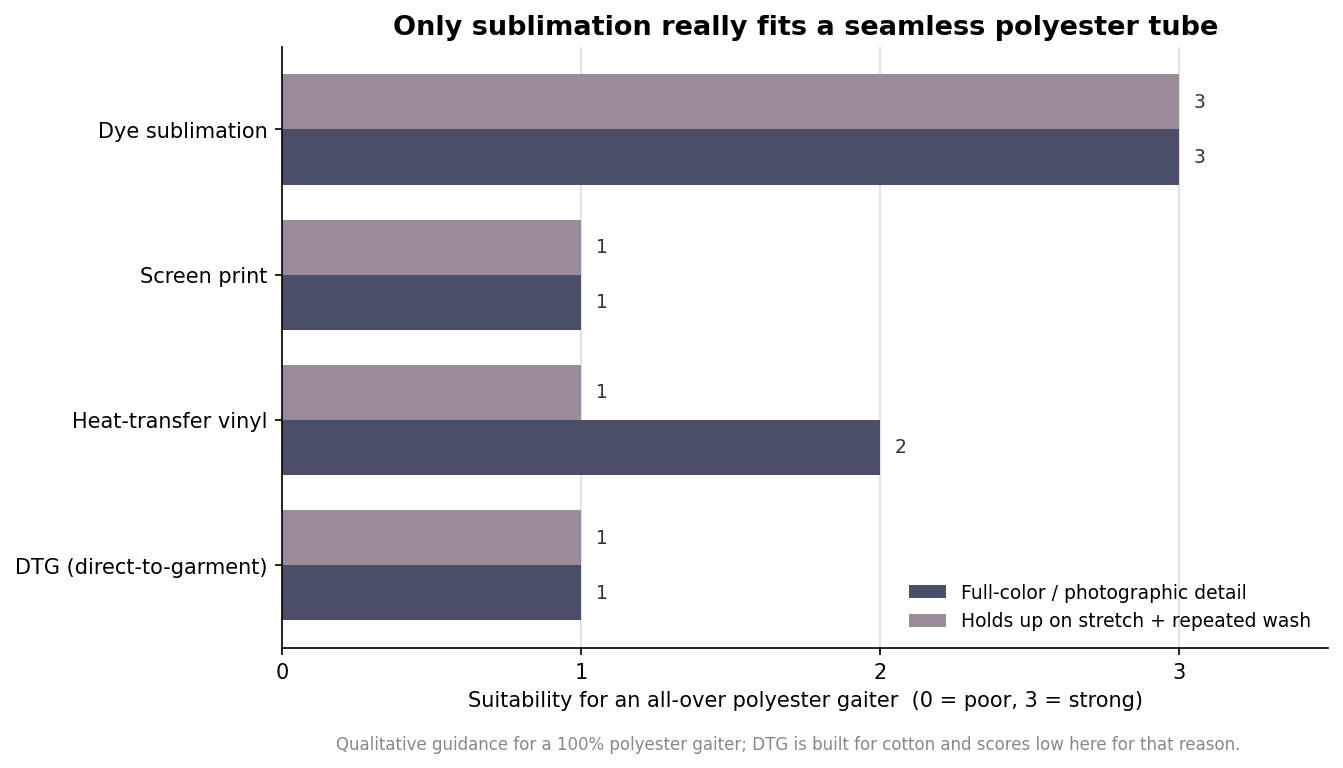
    The alternatives are not useless, they are just built for different jobs. Screen printing lays ink on the surface and shines on cotton tees and tote bags, where it is durable and cost-effective at high volume. On a stretchy polyester tube it struggles: it is limited on gradients and color count, adds a hand feel, and the ink film can crack where the fabric flexes. It is vibrant on dark fabric, which is the one area sublimation is weak, but that rarely offsets its problems on a gaiter. Heat-transfer vinyl cuts a solid-color shape and presses it on; it is fine for a small, simple logo or a name, but a vinyl patch on something that stretches and folds is a strong candidate to peel over time. Direct-to-garment printing is designed for cotton and does not bond well to polyester, so it is essentially the wrong tool here despite being excellent elsewhere.

    In short, reach for an alternative only when the design is a small, simple, single-color mark, or when the blank itself is not polyester. For anything full-color, all-over, or performance-oriented, sublimation is not just the best option, it is close to the only one that holds up.

    Grouped horizontal bar chart rating dye sublimation, screen printing, heat-transfer vinyl, and DTG on full-color detail and durability on a stretchy polyester gaiter, with sublimation scoring highest on both
    On a seamless polyester tube, only dye sublimation scores well on both full-color detail and holding up to stretch and washing.

    What it costs, and how quantity moves the price

    Sublimation carries no per-color setup the way screen printing does, so the price is driven mainly by fabric, size, and quantity rather than by how complex your artwork is. That is why a photographic, ten-color design costs the same to print as a two-color one. What changes the number most is volume. A single sample piece costs far more per unit because the setup is spread across one gaiter, while the same gaiter ordered in volume costs much less each, and the savings flatten out as quantities climb. The steepest per-unit savings come in the first few dozen pieces.

    Two ordering notes follow from that. First, minimums: the minimum order at Customized Neck Gaiters is 12, which keeps small runs possible while still getting you into volume pricing. Second, plan lead time of about 2 weeks for a custom order, since the blanks are printed, heat-set, cut, and sewn to order rather than pulled from a shelf. If you need a specific in-hands date, build that timeline in from the start, and order a small buffer over your headcount.

  • How to Wear a Neck Gaiter: 11 Styles and Which Fabric Fits Each Use

    How to Wear a Neck Gaiter: 11 Styles and Which Fabric Fits Each Use

    A neck gaiter is deceptively simple: one seamless tube of stretch fabric with no buttons, no ties, and no front or back. That simplicity is exactly why it has become a staple for anglers, skiers, runners, and event organizers alike. The same tube can sit around your neck on a cool morning, ride up over your nose when the wind picks up, or fold down into a headband when you start to sweat. Learning the handful of ways to wear one, and matching the fabric to what you actually do outdoors, is the difference between a gaiter you forget you are wearing and one that lives at the bottom of a drawer.

    One piece of fabric, and why the shape matters

    Most gaiters are cut from a single rectangle of four-way stretch knit, then either sewn into a tube with one flat seam or knit seamlessly in the round. A common finished size is roughly 9.8 by 19.7 inches laid flat (about 25 by 50 cm), which stretches to fit almost any adult head and neck. The seamless versions have no ridge to chafe under a helmet or hat, while seamed tubes are typically a little cheaper to produce at low volumes. Because the fabric is knit rather than woven, it recovers its shape after being pulled over your head dozens of times a day, and it breathes far better than a folded bandana of woven cotton.

    The lack of a fixed front is the whole point. There is no correct orientation, so you can reposition the tube on the move without breaking stride, and any all-over print reads the same from every angle. That freedom is what makes the styling options below possible.

    Eleven ways to wear a neck gaiter

    The default position gives the product its name: stretch the tube, drop it over your head, and let it rest around your neck as a light collar against sun and wind. From there, pulling the front up over your mouth and nose creates a half face cover that most cyclists and hikers use for dust and glare, and pulling it higher until it reaches your ears and the back of your head becomes a full face cover for cold, wind-driven conditions.

    Stretched over the whole head and tucked under the chin with a second layer below the eyes, the tube works as a balaclava and helmet liner for skiing. Pulled up and back it forms a hood that keeps heat in and holds sunglasses and hair in place. In hot weather, draping the fabric from your hairline down the back of the neck, sometimes called the Saharan or legionnaire style, shades your neck while staying breathable, and a knotted pirate wrap keeps sweat out of your eyes during watersports.

    The rest of the repertoire is about your head. Turned inside out and twisted, the tube becomes a beanie; half-stretched across the forehead it is a bandana that filters UV during a summer workout; wrinkled and set low on the brow it is a sweat-catching headband for running; and folded one-third over the crown it forms a durag-style cap for casual wear. That is eleven distinct configurations from a single piece of fabric, which is why one gaiter often replaces a hat, a mask, and a headband in a packed bag.

    Horizontal bar chart of indicative neck gaiter fabric weight ranges by type in grams per square meter
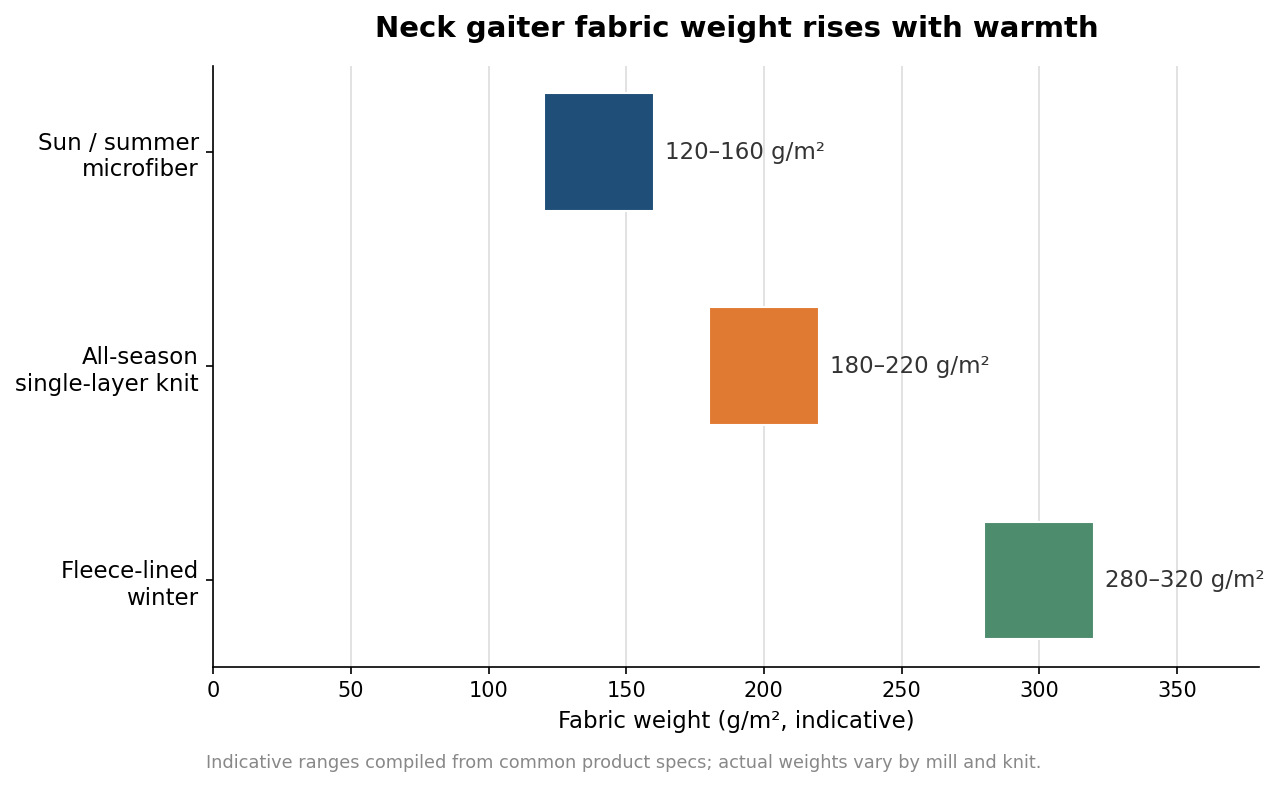
    Fabric weight is the fastest way to tell a summer sun gaiter from a winter one.

    Match the fabric weight to the job

    Not all gaiters are built for the same weather, and the quickest tell is fabric weight measured in grams per square meter. Sun and summer gaiters are usually thin 100% polyester microfiber in the range of about 120 to 160 g/m², light enough to soak and evaporate for evaporative cooling, and rated UPF 50+ when the knit is tight enough to block roughly 98% of UV. All-season single-layer knits sit around 180 to 220 g/m² and add a little wind resistance without becoming stifling. Fleece-lined winter tubes jump to roughly 280 to 320 g/m², trading breathability for warmth around the neck on cold days. These bands are indicative rather than exact; the same weight can feel warmer or cooler depending on knit structure and whether the fabric is brushed.

    The practical rule is to buy for the condition you face most. A fishing or trail gaiter that will spend hours in direct sun wants the lightest UPF microfiber you can find, because a heavy fleece will leave you overheated by mid-morning. A ski or commuter gaiter that mostly fights cold wants the fleece weight, and an all-purpose one for mixed spring and fall use lands comfortably in the middle band.

    Printing and ordering custom gaiters in bulk

    Because the base fabric is polyester, gaiters are almost always decorated by dye sublimation, a process where heat turns solid dye into gas that bonds directly into the fibers. The result is an all-over, full-color print with no raised ink layer, nothing to crack or peel, and no loss of stretch or breathability. That makes gaiters an unusually good canvas for photographic camo, gradients, repeating logos, or full-bleed team artwork that a screen print could never wrap around a tube cleanly. For artwork, design to the flat panel dimensions and allow bleed on all edges, since there is no seam allowance to hide a misregistered logo.

    The minimum order at Customized Neck Gaiters is 12, and unit cost falls with volume, so a full club or team order is best priced as one quote. The quote form gives you a firm number with a free mockup.

    Choosing the right gaiter for your use case

    Start from the dominant condition rather than the color. If your day is defined by sun exposure on water or open trail, choose the lightest UPF 50+ microfiber and plan to wear it as a half or full face cover with a Saharan drape when the sun is high. If cold and wind define the day, size up to a fleece weight and expect to live in the full face cover and balaclava positions. For high-output activity like running or cycling in mild weather, a mid-weight knit worn as a headband or neck collar sheds heat while still there when you need it. And if you are buying for a group or promotion, prioritize a full-color sublimated print on a versatile mid-weight tube, since it photographs well, suits the widest range of wearers, and is cost-effective once you order in volume. Get those two decisions right, fabric weight and print, and the eleven ways to wear it take care of themselves.

  • What UPF 50+ Really Means on a Neck Gaiter

    What UPF 50+ Really Means on a Neck Gaiter

    A neck gaiter is marketed as sun protection more often than almost any other quality, and the shorthand for that claim is a UPF number, usually UPF 50+. The rating is real and it is measurable, but it is easy to misread, both by buyers who assume a bigger number is dramatically better and by sellers who print the figure without saying how it was earned. If you are ordering custom gaiters in any quantity, it pays to understand exactly what the rating describes, how it is tested, and what everyday use does to it, because the difference between a labeled number and delivered protection comes down to a few specifics.

    UPF measures fabric, not sunscreen

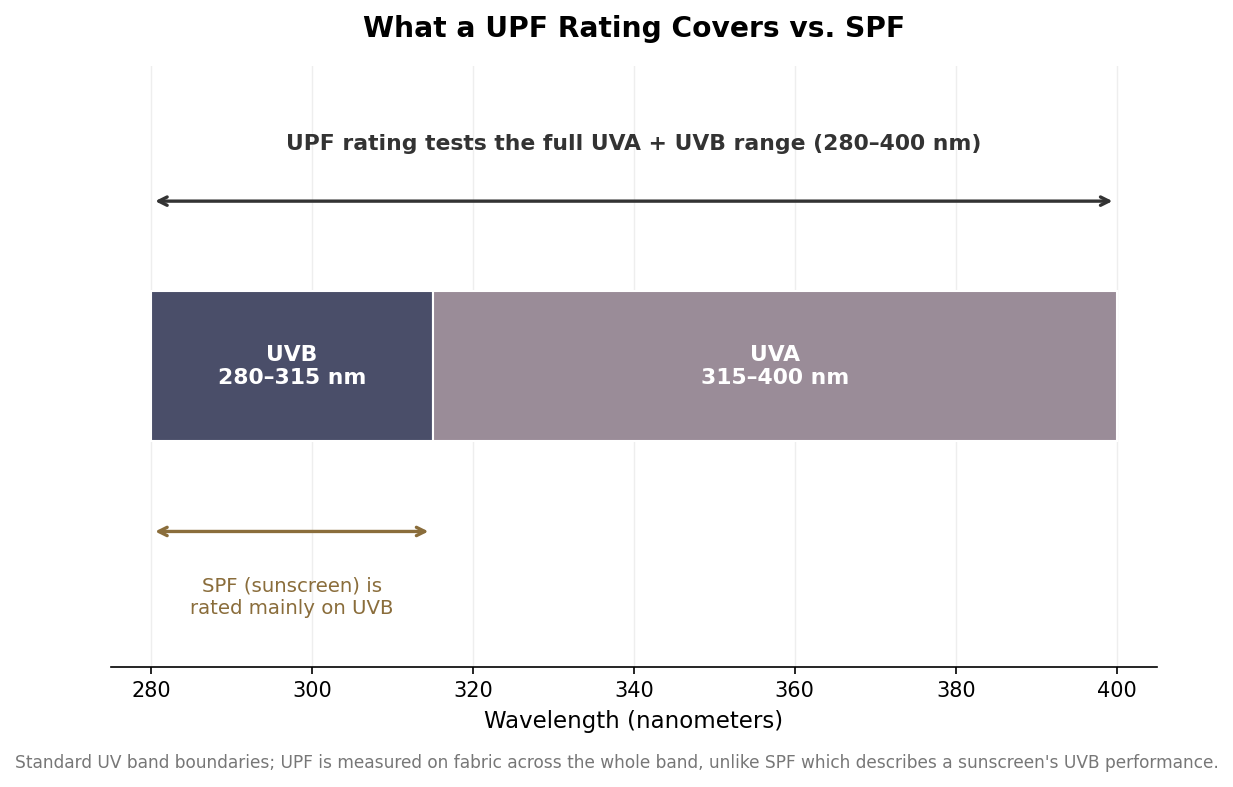
    UPF stands for Ultraviolet Protection Factor, and it describes how much ultraviolet light a fabric lets through to the skin. This is a different thing from SPF, the number on a bottle of sunscreen. SPF rates a topical product and is driven mainly by protection against UVB, the sunburn band of the spectrum. UPF rates a textile across the whole ultraviolet range that reaches the ground, both UVA and UVB, so it speaks to a broader kind of exposure than an SPF figure does. When a gaiter says UPF 50+, it is making a claim about the cloth itself blocking UV, independent of anything you put on your skin.

    Diagram of the ultraviolet spectrum from 280 to 400 nanometers showing the UVB and UVA bands and that UPF tests the full range while SPF is rated mainly on UVB
    UPF rates a fabric across the full UVA and UVB range; SPF describes a sunscreen’s UVB performance.

    What the rating number actually means

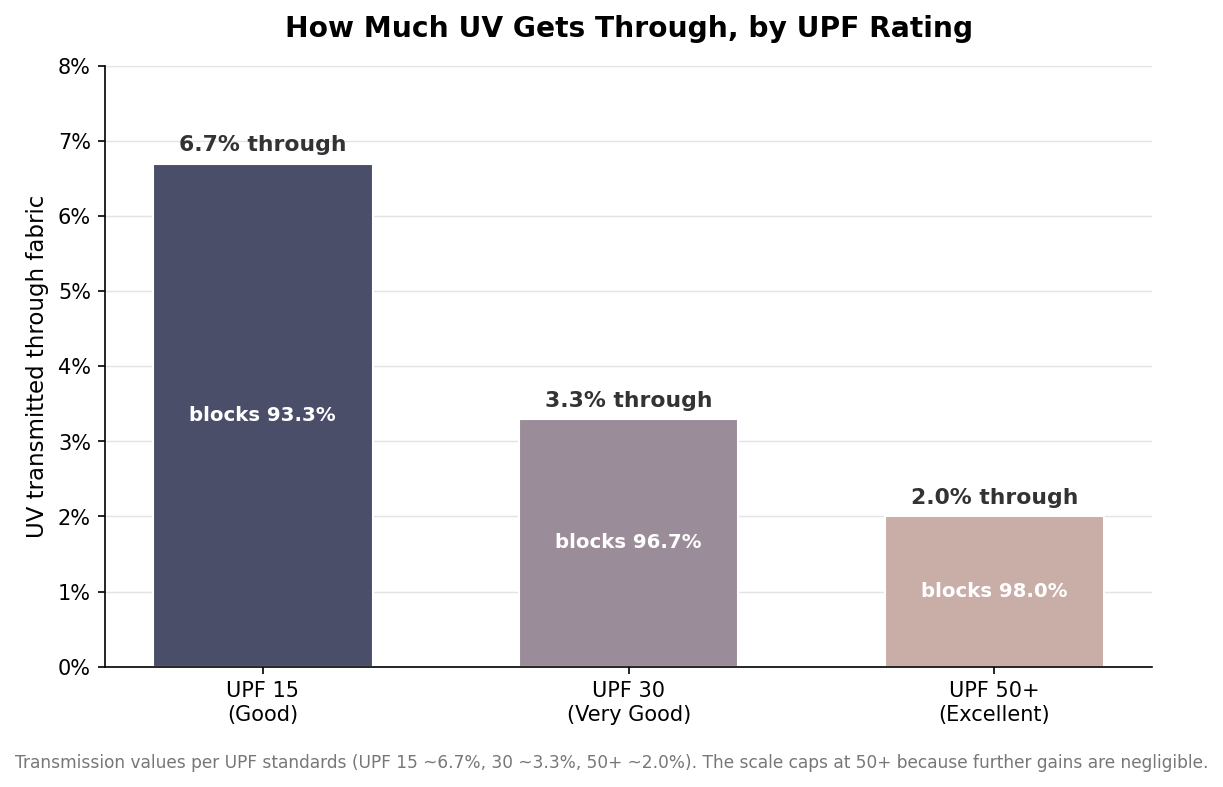
    The UPF scale is banded into three named tiers. UPF 15 to 24 is rated Good, 25 to 39 is Very Good, and 40 to 50+ is Excellent. Translated into how much UV is stopped, a UPF 15 fabric blocks about 93.3 percent of UV and lets roughly 6.7 percent through; UPF 30 blocks about 96.7 percent; and UPF 50 blocks close to 98 percent, with only about 2 percent getting through. The scale deliberately stops at 50+ because the gains above that point are small in absolute terms. Moving from UPF 15 to UPF 50 roughly cuts the UV reaching your skin from about one-fifteenth to one-fiftieth, but moving from UPF 50 to some hypothetical UPF 80 shaves off a fraction of a percent that has little real-world meaning. Reading the numbers as transmission rather than as a bigger-is-always-better score makes the diminishing returns obvious.

    Bar chart of the percent of UV transmitted through fabric at UPF 15, 30, and 50+, showing 6.7, 3.3, and 2.0 percent with diminishing returns
    Higher UPF blocks more UV, but the gains shrink, which is why the scale caps at 50+.

    How UPF is tested in a lab

    The rating comes from an instrument, not an estimate. In the United States the standard is AATCC 183, and internationally the closely related AS/NZS 4399 from Australia and New Zealand is used; the two are substantively similar. A laboratory places a fabric sample in a spectrophotometer, which shines ultraviolet light through the cloth and records how much passes through at each wavelength, typically in five-nanometer steps across the 280 to 400 nanometer range that covers both UVB and UVA. Those transmission readings are combined into the single UPF figure you see on the label. One caveat is worth knowing: the base AATCC 183 rating does not require wash-durability testing as a condition of the initial number, so a fabric is rated as tested, not necessarily as it will perform after a season of laundering. Manufacturers can run and report post-wash results separately, and a supplier who has done so is worth asking.

    What raises or lowers a gaiter’s real protection

    Several properties of the fabric decide where it lands on the scale, and most of them are within a buyer’s control when specifying a custom run. Knit tightness matters most: densely constructed cloth leaves less space between yarns for UV to slip through, so a tight microfiber knit outperforms an open, airy one. Color counts too, because darker and more saturated shades absorb more UV than pale ones, which means a navy or black gaiter generally protects better than a light heather at the same fabric weight. Fiber choice pushes the same direction: polyester and nylon disrupt UV effectively on their own, while untreated natural fibers like cotton let more through unless they are specially finished.

    Two use conditions specific to gaiters can quietly erode the rated number. Moisture lowers UPF for many fabrics as water fills the gaps and changes how light passes through, though some synthetics hold their protection better when wet than natural fibers do. And stretch is the one most people overlook. A gaiter is a tube pulled over the head and often stretched across the nose and cheeks; a fabric stretched thin has more space between its yarns and loses a meaningful share of its protection exactly where it is stretched tightest. A rating measured on a relaxed sample is a best case, so fit and fabric weight matter for holding the number in real use.

    What to ask for when you order

    Specifying protection well is mostly a matter of asking the right questions before a run. Ask for the tested UPF and the standard it was measured against, AATCC 183 or AS/NZS 4399, rather than accepting an unsourced “UPF 50+” on its own. If the gaiters will be laundered often, ask whether the fabric has any post-wash UPF data, since the base rating does not guarantee durability. Where sun performance is the point, lean toward a tighter synthetic knit in a deeper color and a fabric weight that will not sheer out when stretched over the face. Printing and dye methods can also interact with the base fabric’s protection, so if you are sublimating a full-coverage design, it is reasonable to ask the supplier how the finished, printed gaiter tests rather than assuming the blank’s rating carries straight through. None of this requires you to become a textile chemist; it just means treating the UPF number as a tested result with conditions attached, which is exactly what it is.

  • Neck Gaiter Fabrics Compared: Fleece, Merino, and UPF Sun Microfiber

    Neck Gaiter Fabrics Compared: Fleece, Merino, and UPF Sun Microfiber

    Ask what makes a good neck gaiter and the honest answer is the fabric, because everything a gaiter does well or badly comes from the cloth it is cut from. A thin sun-blocking tube and a warm winter fleece neck gaiter can look almost identical flat on a table, yet they behave like completely different products in use. If you are choosing one to wear, or specifying a custom run to print, it pays to compare the fabrics on the numbers that actually matter: weight, warmth, sun rating, and whether your design can be printed on them at all.

    The fabric decision starts with temperature

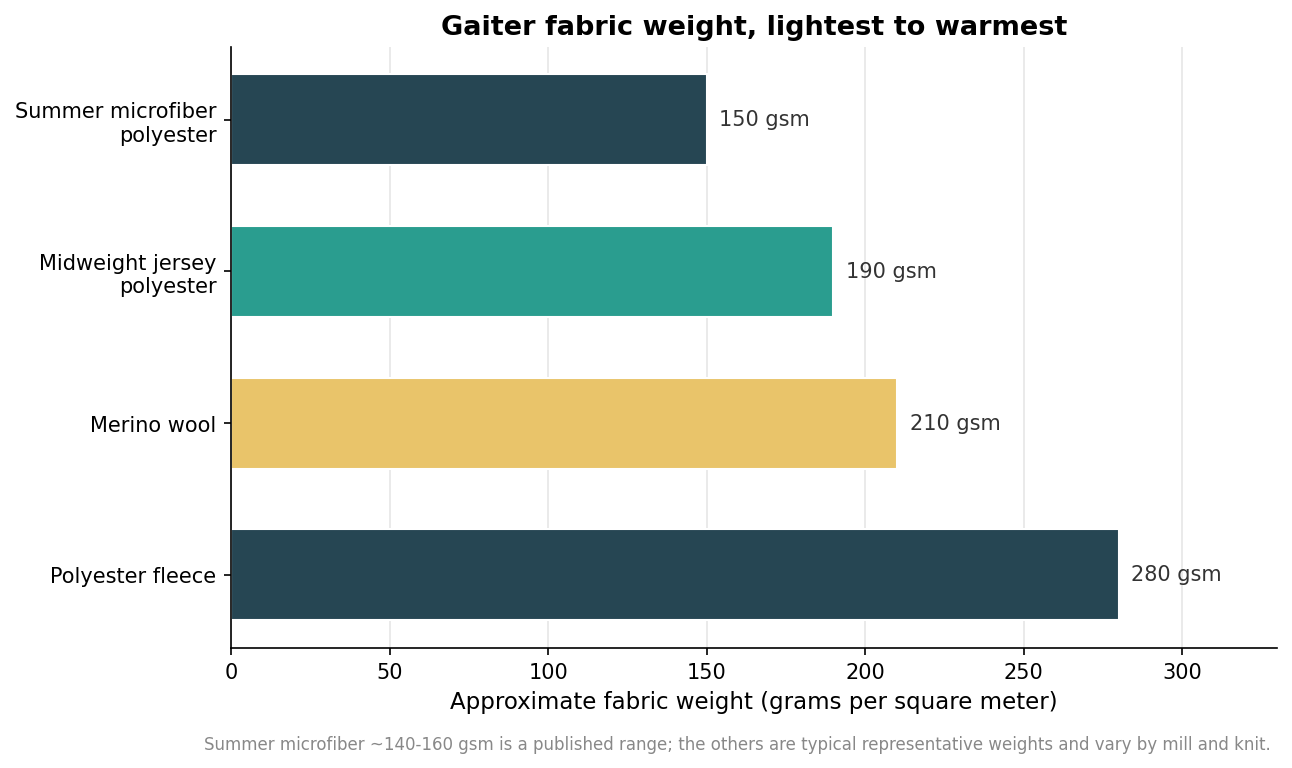
    Gaiter fabrics sort themselves out by weight, measured in grams per square meter, and weight maps closely to how warm the tube feels. The lightest and most common gaiter cloth is moisture-wicking microfiber polyester in the range of about 140 to 160 gsm, thin enough to breathe in summer heat and pull sweat off the skin. A midweight polyester jersey around 180 to 200 gsm adds a little more coverage for shoulder seasons without becoming hot. Merino wool sits in a similar weight band but trades differently: it holds warmth better for its weight and resists odor over multiple wears, which is why it dominates cold-weather travel. At the top end, polyester fleece around 250 to 300 gsm is built purely for cold, trapping air against the neck for skiing and winter work. The chart below lines these up so you can see the jump from a summer tube to a winter one.

    Horizontal bar chart of approximate gaiter fabric weight in gsm: summer microfiber polyester 150, midweight jersey 190, merino wool 210, polyester fleece 280
    Fabric weight rises from light summer microfiber to heavy winter fleece; weight is the fastest proxy for warmth.

    The practical takeaway is that no single gaiter covers every season. A 150 gsm sun tube will not keep you warm on a chairlift, and a fleece will cook you on a July hike. Buyers who need year-round coverage are really buying two products.

    What UPF actually measures

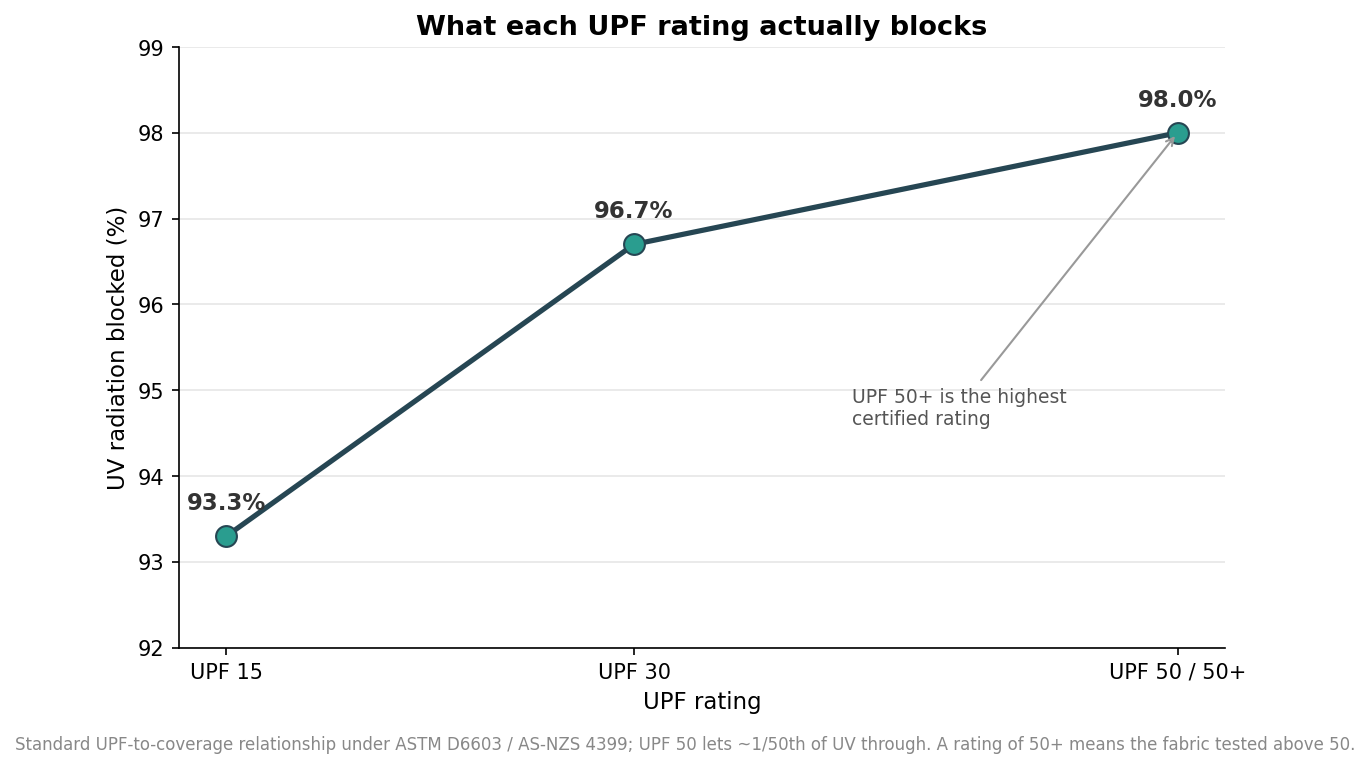
    For any warm-weather or water gaiter, the sun rating is the headline spec, and it is more precise than most people assume. UPF, or Ultraviolet Protection Factor, tells you what fraction of ultraviolet radiation the fabric blocks. A UPF 50 rating blocks about 98 percent of UV, letting only one-fiftieth reach the skin, and UPF 50+ is simply the highest certified step, meaning the fabric tested above the 50 threshold under the ASTM D6603 and AS/NZS 4399 standards. A UPF 30 fabric still blocks close to 97 percent, so the gap between tiers is smaller than the numbers suggest, but for a full day on the water the top rating is worth it. The chart below shows how the ratings translate into actual coverage.

    Line chart of UPF rating versus percent of UV radiation blocked: UPF 15 blocks 93.3 percent, UPF 30 blocks 96.7 percent, UPF 50 and 50+ block 98 percent
    UPF ratings translate directly to UV blocked; UPF 50 stops about 98 percent, and 50+ is the certified maximum.

    Two caveats matter when you buy. Tightly knit synthetic fibers like polyester and nylon carry the highest and most stable ratings, while cotton and cotton blends can lose much of their UPF when they get wet, exactly when a fishing gaiter is soaked with spray and sweat. The good news is that a quality synthetic UPF rating holds up through 50 or more wash cycles before it starts to degrade, so a well-made sun gaiter protects for seasons, not weeks.

    Which fabrics you can actually print

    This is where a custom order narrows the field, and it surprises a lot of first-time buyers. Full-color, edge-to-edge custom graphics on gaiters are almost always produced by dye sublimation, a process where the ink turns to gas under heat and bonds into the fiber itself. That bond only forms with synthetic polymers, so sublimation needs polyester, ideally 100 percent and at minimum around 65 percent, to reproduce vivid color. Cotton and wool cannot be sublimated directly because the dye has nothing to bond to and the print washes out, and poly-cotton blends come out muted and vintage-looking. Because sublimation inks are translucent and cannot lay down white, the base fabric has to be white or very light for colors to stay true. The upside is durability: a sublimated design becomes part of the cloth, so it will not crack, peel, or fade the way a surface print does, surviving repeated washing. The practical rule for custom work is simple: if you want a bold all-over print, specify white 100 percent polyester, and understand that a merino or dark gaiter is a stock-color product, not a full-color canvas.

    Matching fabric to how it will be used

    With weight, UPF, and printability in view, the use case chooses the fabric. Anglers, paddlers, and anyone working in direct summer sun want light microfiber polyester with a UPF 50+ rating, because coverage and moisture management beat everything else there. Runners and cyclists want the same light poly for breathability but rarely need the maximum sun rating unless they train midday. Skiers, snowmobilers, and cold-weather crews want polyester fleece for raw warmth, accepting that it is bulkier and not a print surface. Long cold days where you sweat and then chill, common in hunting and backcountry travel, favor merino wool for its warmth-to-weight and odor resistance, at a higher price and with no full-color printing. Team, event, and promotional buyers almost always land on white polyester because it is the only fabric that carries a custom design cleanly.

    Specifying a custom bulk order

    When you move to a branded run, put the numbers in the spec so the sample matches the intent. State the fabric weight you want in gsm, since “polyester” alone can mean a 150 gsm sun tube or a 300 gsm fleece. If sun protection is a selling point, ask for the tested UPF rating rather than a vague “UV” claim, and confirm it is rated on the synthetic fabric you are ordering. For full-color artwork, specify white 100 percent polyester and supply high-resolution files, because sublimation reproduces fine detail but only as well as the file allows. Finally, plan care instructions into the product: cold wash, no bleach or fabric softener, and air or low-heat drying keeps both the UPF rating and the printed color intact. Nail the fabric weight, the UPF number, and the polyester base, and the gaiters you receive will do the job you pictured, in the season you bought them for.

  • Designing Artwork for Something With No Front

    Most artwork arrives designed for a t-shirt: one logo, centered, on a flat front. A tube has no front, and it turns.

    Think in repeats, not in placements

    Whatever you print will end up somewhere unpredictable, because the wearer rotates the tube without thinking. The reliable answer is a repeating pattern with the mark appearing several times around the circumference.

    Two or three repeats is usually enough for the brand to be visible from any angle without the garment looking like a billboard.

    Allow for the fold

    A gaiter is worn folded at the neck about as often as it is worn full height. Anything placed in the middle of the tube spends half its life hidden inside a fold.

    Keep important marks in the upper third and the lower third, and treat the middle band as pattern.

    Remember it stretches

    Four-way stretch fabric distorts under tension, and it distorts most across the widest part of the neck. Fine lines and small type suffer first.

    Heavier weights, especially brushed fleece, also soften edges slightly. We flag it at mockup stage when artwork has detail that will not survive.

    Color matching

    Sublimation matches a color reference closely and we send a printed swatch before any large run — screens lie, and team colors are the thing people notice.

    Merino is dyed rather than printed and matches less precisely. If an exact team color is essential, choose a printed polyester and use merino for solid neutral colorways.

  • The Complete Buyer’s Guide to Neck Gaiters

    A gaiter is a tube of knitted fabric. Four decisions separate one that lives in a jacket pocket all season from one that goes in a drawer.

    Weight, in gsm, decides the season

    Around 120 to 150 gsm is a summer and sun weight: light, breathable, quick drying, and designed to be soaked for cooling. Mid weights suit year-round club use.

    Winter wants a split tube — brushed fleece at the neck, lighter knit over the mouth. A gaiter that is fleece all the way up traps breath, goes damp within minutes and gets pulled down, which is why it feels warm in a shop and cold on a hill.

    Seamless beats stitched, every time

    The side seam of a stitched tube sits against the throat and is felt on every head turn. It is the single most common reason a gaiter stops being worn, and a seamless knit costs very little more.

    If a supplier does not mention construction, assume it is stitched.

    The edge is where cheap gaiters fail

    Knitted polyester cut with scissors frays, then rolls into a tight cord that digs in. A laser-cut edge seals as it cuts and does neither.

    Look at a sample edge under good light. You can see the difference immediately, and it predicts how the garment will look after ten washes.

    Ratings only count if they are tested

    UPF 50+ is a measured fabric property, not a description. Ask for the tested rating in writing; ‘sun protective’ on its own means nothing.

    The same discipline applies to high-visibility. Fluorescent fabric and reflective tape work, and certification applies to garments that have been certified — which a neck tube has not been. Treat any supplier who blurs that line with caution.

    What to send when you ask for a quote

    Fabric and weight, quantity, sizes including youth if you need them, artwork, and any event date. That is enough for a real quote and a mockup the same day.

    Remember that a tube has no front. Artwork usually needs rethinking as a repeating pattern rather than one logo on one face — we redraw it free.

  • Are Neck Gaiters Face Masks? No.

    This question comes up constantly and it deserves a plain answer rather than a carefully worded one.

    What a gaiter actually does

    It blocks wind. It blocks sun, and with a tested UPF fabric it does so measurably. It keeps dust and grit off the lower face on a dry trail, and it keeps a neck warm.

    Those are real, useful jobs, and they are why the garment sells in millions.

    What it does not do

    It does not filter what you breathe. A single layer of knitted stretch fabric has an open structure by design — that is what makes it breathable and comfortable, and it is exactly what a filtering material must not be.

    Where filtration is genuinely required, the correct product is a certified mask or respirator, chosen for the hazard. No gaiter substitutes for one.

    Why we say so

    Because a buyer who is told otherwise finds out later, and because a product sold on a claim it cannot support damages every other claim we make.

    We would rather send somebody to a different product than sell a gaiter as protection it is not.

    The same rule for hi-vis

    Fluorescent knit and retro-reflective banding make a person much easier to see, especially at head height where a driver is looking.

    That is a visibility aid. Certified high-visibility clothing is a tested garment class, and the certification lives on the vest or jacket. Our gaiters are worn alongside it, never instead of it.